



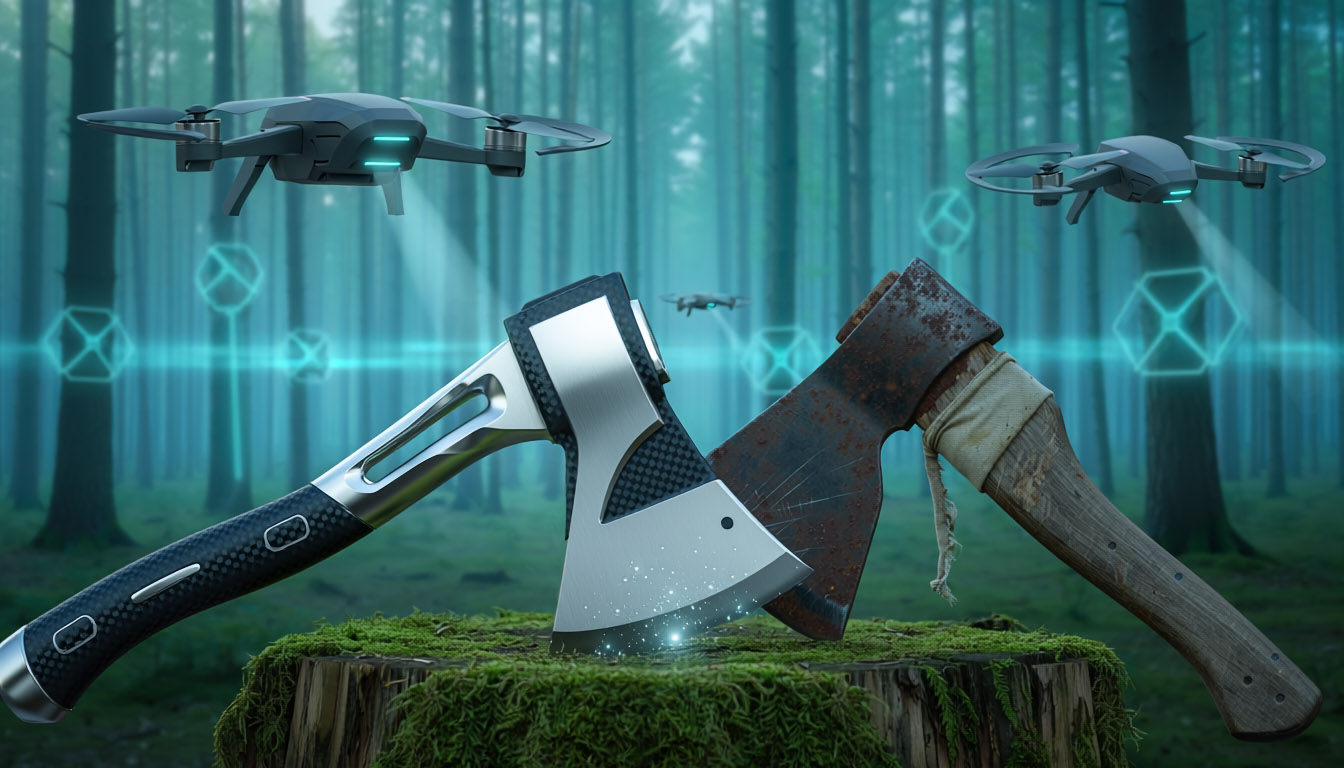
Two lumberjacks worked side by side in the same forest, starting at sunrise each morning. Both were strong. Both were disciplined. Both attacked their work with the same ferocious intensity. From a distance, you would have said they were equals.
But every afternoon, around two o’clock, one of them disappeared. He would gather his things, say nothing, and walk off toward the tree line. He was gone for about an hour, then he came back and worked until dark.
The other lumberjack stayed put the entire day. He watched his counterpart slip away every afternoon and quietly seethed. He figured it was laziness. He figured he was being taken advantage of somehow. He worked harder to compensate, swinging with everything he had, refusing to slow down for even a moment.
At the end of each week, when they tallied the wood, the one who left every afternoon had cut significantly more.
This went on for weeks. The harder worker was baffled. He was furious. He was also, if he was honest with himself, a little humbled.
Finally he asked. He pulled his rival aside and demanded to know the secret. How was it possible to put in fewer hours and produce more? What was the trick?
The answer was not what he expected.
“I go home to sharpen my axe.”
That was it. No secret. No trick. No shortcut that cheated the work. The man who was winning simply understood that the sharpness of the blade mattered as much as the strength of the swing. He invested an hour each day making himself more capable, and that hour paid dividends in every hour that followed.
The other man had been so busy working hard that he never stopped to work smart.
Your Axe Is Dull Right Now
If you have spent any time in technology over the past couple of years, you have watched an era unfold that does not arrive quietly. AI tools are changing how software gets built, and they are not changing it subtly.
GitHub Copilot can suggest entire functions while you type. Claude can review a pull request and surface issues a human reviewer might miss. ChatGPT can take a dense incident post-mortem and produce a clean summary in thirty seconds. AI models can generate a first draft of unit tests for a function you just wrote, draft your architecture decision records, and help you think through tradeoffs on a system design.
None of these tools are magic. None of them replace the engineer. But all of them are whetstones, and if you are not picking them up, your axe is getting duller while everyone else’s gets sharper.
The knowledge worker’s axe is attention. It is the ability to focus on the problems that require real judgment and real experience, rather than spending that focus on mechanical work that a well-prompted model can handle. Every hour you reclaim from boilerplate is an hour you can spend on the work that actually defines your value.
The engineers who are winning right now are not the ones who have abandoned their craft. They are the ones who have turbocharged it. They write the same quality of code they always have, they just write it faster, with better test coverage, and with more mental bandwidth left over for the hard problems. They are not being replaced by AI. They are being multiplied by it.
The sharpest axe wins, not the sweatiest brow.
The Resistance Is Real
I want to be honest about something, because I talk to engineers all the time and I know what is actually going on in their heads.
The fear is real.
Experienced engineers and architects who have spent ten or fifteen years building expertise are watching AI tools do passable versions of things they worked hard to learn. That is unsettling. And when their company starts talking about “AI productivity gains” in the same breath as budget discussions, the pattern recognition fires: they are looking for reasons to cut headcount.
That fear is not irrational. Industries have been disrupted before. Typesetters, travel agents, radiologists – every decade brings a new list of professions that looked stable until they did not. It is reasonable to look at a tool that can write code and wonder where you fit.
But there is a crucial difference between “my tools are getting better” and “I am becoming obsolete,” and collapsing those two things is a mistake that will cost you.
The engineers who are best positioned in this new landscape are not the ones who never touched an AI tool. They are the ones who know exactly what AI is good at, what it is bad at, where it needs supervision, and how to direct it toward the right outcome. That is a skill. It is not a trivial one. It requires deep technical judgment to wield these tools well, and the engineers who have spent years building that judgment have a significant advantage over anyone who is just getting started.
Myth: "AI will replace me"
AI generates output. Engineers decide what to build, review what was generated, catch what was wrong, and carry the judgment that no model has yet. The premium is moving toward people who can direct AI well, not away from technical expertise.
Myth: "AI code is bad code"
Sometimes it is. So is the first draft a junior engineer writes without review. The answer is not to avoid the tool, it is to review its output with the same discipline you would apply to any other contribution. AI-assisted teams are shipping faster and catching more issues, not fewer.
Myth: "I'll lose my skills"
Calculators did not make mathematicians worse at math. They freed them to focus on harder problems. The engineers leaning into AI tools carefully are not atrophying. They are tackling more complex problems with the time they reclaim from the routine ones.
Myth: "My company won't notice either way"
Technology leaders at every level are watching AI adoption closely. Boards are asking about it. CTOs are building it into their planning assumptions. The engineers who demonstrate high productivity with AI tools are not invisible, and neither are the ones who have quietly opted out of using them at all.
Avoidance Is Not Neutral
Here is the thing about keeping your head down and waiting for the AI wave to pass: it is not a neutral position. It feels like standing still. It is actually moving backward.
While you are deliberately not sharpening your axe, other engineers are sharpening theirs every day. They are getting faster. They are building intuition for how to prompt well, when to trust the output, and when to push back. They are accumulating a kind of fluency that takes time to develop, and that time compounds.
The job market for engineers is already bifurcating. Hiring managers talk about it openly. There is growing demand for engineers who are comfortable with AI-assisted workflows, and growing skepticism about those who have no experience with them. This is not speculation. It is a shift that is visible right now in how roles are being written, evaluated, and compensated.
Avoidance does not protect your job. It just means that when the choice is made about who to bet on for the next few years, the person who sharpened their axe looks like the better investment. The lumberjack who refused to stop swinging is still out there in the forest, working as hard as he ever did, wondering why everything keeps getting harder.
The engineer who won't sharpen the axe isn't protecting their job. They're quietly handing it to someone who will.
How to Start Sharpening
You do not need to transform your entire workflow overnight. You do not need to become a “prompt engineer” or read every paper that comes out of the major AI labs. You just need to pick one thing and try it.
The engineers I have watched make the fastest progress all started the same way: they found one genuinely tedious part of their day and handed it to an AI model. Not their favorite parts. Not the interesting problems. The part that eats time without requiring much thought – writing test scaffolding, drafting a ticket description, summarizing a long thread, translating a legacy function to a new pattern.
They ran that experiment for a week or two. Most of them came back saying the same thing: it was not perfect, but it saved them real time, and they could see how to make it better. Then they expanded to the next workflow.
The goal is not automation. It is augmentation. You are still the engineer. You still carry the judgment, the taste, the accountability. You are just doing it with a tool that is actually sharp.
AI-Assisted Code Review
Run a pull request through an AI model before asking your team for review. You will catch issues you might have missed, and your reviewers will spend their time on the things that actually require human judgment.
Documentation Generation
Ask an AI to produce a first draft of your README, your ADR, or your API docs. Edit it down to what is accurate and useful. The blank page problem disappears, and the quality bar on your documentation goes up.
Architecture Brainstorming
Use AI as a rubber duck that talks back. Describe a design problem and ask for the tradeoffs between three approaches. You will not always agree with what it says, but it will surface considerations you might not have hit until later.
Test Generation
Give an AI your function signature and ask it to generate a test suite covering the happy path, edge cases, and failure modes. Review every test it writes -- but let it do the heavy lifting on coverage you would have otherwise skipped.
Incident Summarization
Paste your incident timeline into a model and ask for a structured post-mortem draft. The factual summary writes itself. You spend your energy on the root cause analysis and the action items -- the parts that actually require you.
Ticket and Meeting Summarization
Long Slack threads, meeting notes, and sprawling Jira tickets are cognitive overhead. Summarize them in seconds, extract the decisions and the open questions, and get back to the work that matters.
None of these workflows require deep AI expertise. They require a willingness to try something, a critical eye for the output, and a habit of iterating until the tool is actually useful in your context. That is it. The axe sharpens itself through use.
How VergeOps Can Help

At VergeOps, we work with engineering organizations at exactly this inflection point. The companies that are getting the most out of AI tooling are not the ones that simply told their teams to “use AI more.” They are the ones that built deliberate practices: clear guidance on which tools are approved, frameworks for reviewing AI-generated output, and a culture that treats AI fluency as a professional skill worth developing.
We help engineering leaders design and implement AI adoption programs that stick. That includes assessing where your teams are today, identifying the highest-leverage workflows for automation and augmentation, and coaching engineers through the learning curve in a way that builds confidence rather than anxiety. We also work with organizations to measure the impact – because productivity gains are real, but they need to be tracked to be credible to the business.
If your organization is trying to figure out how to move from “we have access to these tools” to “we are actually better because of them,” that is a conversation worth having. Reach out to the VergeOps team and let’s talk about what sharpening your axe looks like at your scale.